Mechanical pollination and maximum screening
Project goal
The goal of this project is to investigate the potential of mechanical pollination in tomato cultivation under full-LED lighting. Pollination by bumblebees requires the screens to be opened; preventing this can save 12% energy. Furthermore, opportunities will be created to illuminate at less expensive times.
Project description
In tomato cultivation under full LED, the screens are opened daily to allow daylight in. Bumblebees need UV light from daylight for orientation. Without it, pollination decreases, and with it, fruit set, quality, and production. If pollination can be performed mechanically by a robot, the energy screen can remain closed, resulting in an energy saving of 12%. Mechanical pollination can also lead to more flexibility in lighting hours.
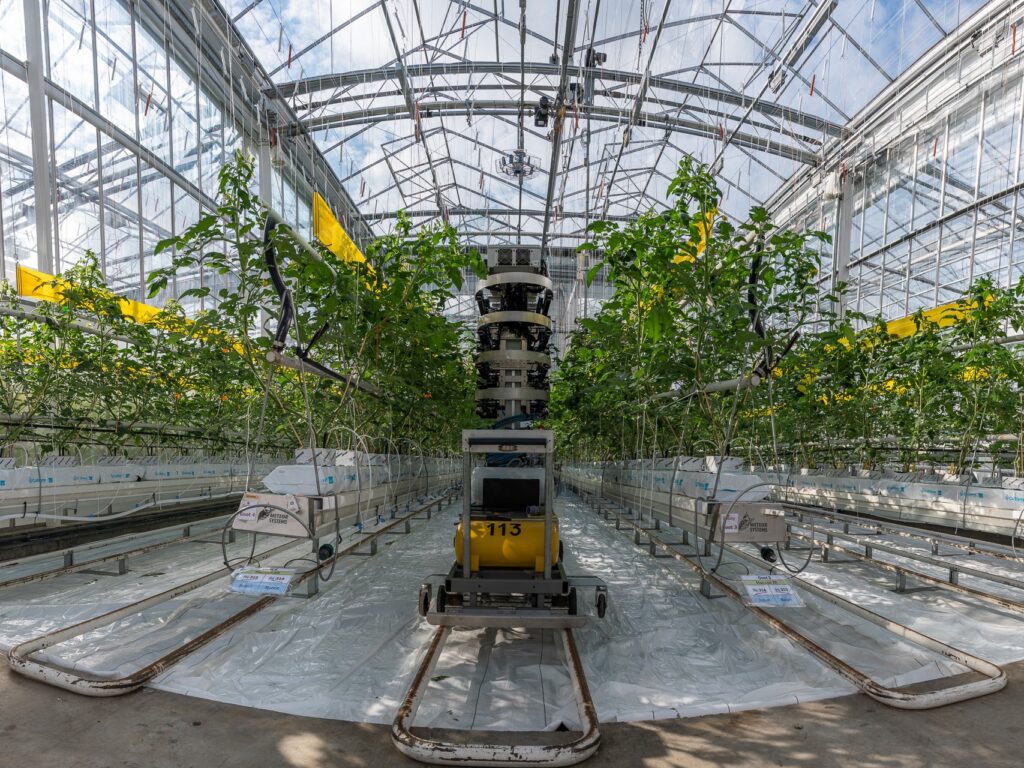
The potential of mechanical pollination is being investigated using an Arugga robot called “Polly+.” The research is being conducted in a lit tomato crop at the Delphy Improvement Centre, in three greenhouse sections: a reference with bumblebees where the screens are opened, a treatment with a robot where the screens remain closed, and a treatment with a robot where the screens are opened. This last section is necessary to determine the influence of the greenhouse climate on pollination under open and closed screens. In the two sections with pollination by a robot, some rows will also be pollinated manually for comparison.
Research period: September 2025 – May 2026
This project/research was developed within the framework of the “Greenhouse as Energy Source” program, the innovation and action program of the Ministry of Agriculture, Fisheries, Food Security and Nature, and Greenhouse Horticulture Netherlands.