Controlling Lisianthus by cultivation phase: the road to fossil-free?
Project goal
The main goal is to significantly reduce energy input for Lisianthus by optimizing the climate at each cultivation stage. Significant savings are possible by limiting the high evaporation rate of 3-4 L/m²/day. However, a climate that inhibits evaporation leads to tip burn, which harms quality, causes losses, and slows down cultivation. The key question from a horticultural perspective is whether there is a sensitive phase at the beginning of the cultivation period for tip burn, and whether the subsequent phase can be significantly more energy efficient.
Project description
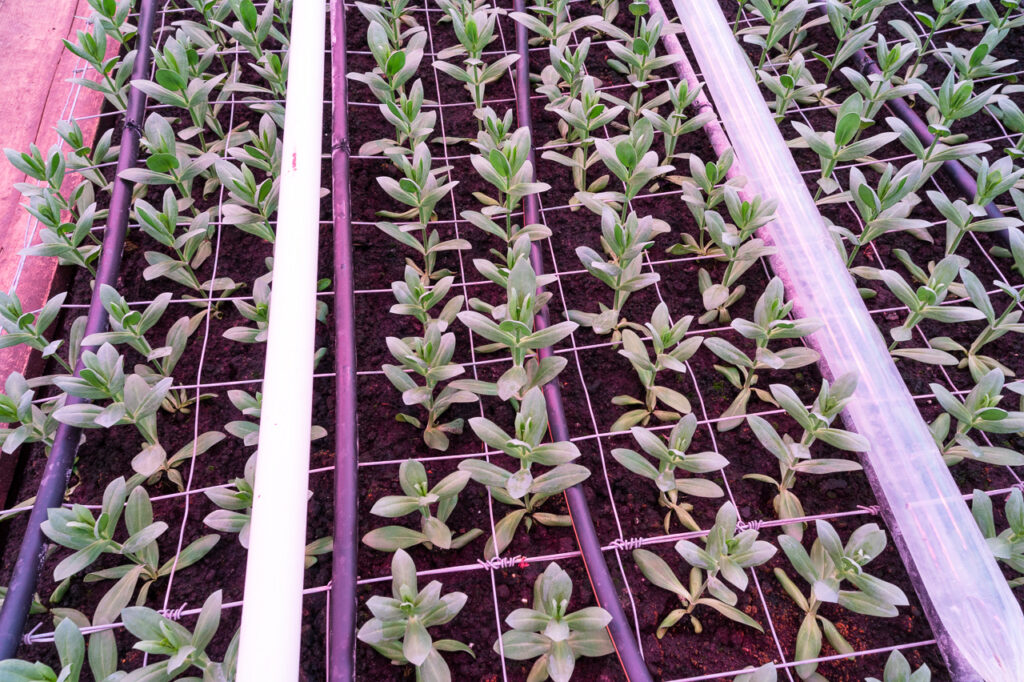
Lisianthus is a very intensive year-round crop, with 500 to 600 stems per m² per year and a high energy input. It uses ample lighting, grows at high temperatures, and the soil is steamed five to six times a year. Lisianthus growers are investing heavily in sustainability. Recent research has led to a good cultivation recipe under LEDs, and growers are implementing this knowledge in practice. This is already resulting in significant savings.
Over the past year, research has been conducted into further reducing heat consumption. Growing in a well-insulated greenhouse under full-LED lighting works well, but a lot of energy is still lost to moisture removal. Especially in the last weeks of cultivation, when the crop has many leaves and the light is at its highest (400 μmol/m²/day for 20 hours), the crop evaporates as much as 3 to 4 liters per m² per day. Removing this much moisture with a condensation dehumidifier is practically impossible.
Reducing evaporation saves a lot of energy. However, there’s a complicating factor: tip burn is a major problem in lisianthus cultivation. It’s a form of leaf edge that seriously damages quality, causes losses, and significantly slows down the crop, which in turn costs a lot of energy. Trials at Plant Lighting have shown that low RH and increased air movement suppress the development of tip burn. Unfortunately, these are precisely the conditions that actually increase crop transpiration. So, a cultivation with low heat consumption and few tip burn seems incompatible. However, there may be an opportunity to significantly reduce transpiration, resulting in fewer, rather than more, tip burn. Tip burn is most noticeable between 1 and 3 weeks after planting. It therefore appears that the sensitive phase for tip burn occurs early in the cultivation process (or even during the propagation phase!).
This project has two work packages:
Work Package 1: Research into the sensitive phase for combustion heads in climate cells at Plant Lighting.
- Is there a sensitive phase for the development of fire tips?
- When and how long does this sensitive phase last?
- How can we further control the prevention of fire tips?
Work Package 2: Greenhouse trial of energy-efficient cultivation without loss of quality.
- In two greenhouses at the Delphy Improvement Centre, cultivation is taking place under full LED according to current standards (greenhouse 1) and
in a climate that suppresses combustion heads and saves energy (greenhouse 2). - In greenhouse 2, the initial focus is on increasing evaporation. This suppresses tip burn, and the additional energy is limited because the crop still has few leaves, so it transpires very little. After the sensitive phase (knowledge from WP1), a climate is transitioned that suppresses evaporation.
- Growth, branch quality and energy savings are measured.
Research period: September 2025 – December 2026
This project/research was developed within the framework of the “Greenhouse as Energy Source” program, the innovation and action program of the Ministry of Agriculture, Fisheries, Food Security and Nature, and Greenhouse Horticulture Netherlands.