GrowSolar – MOOI
Background
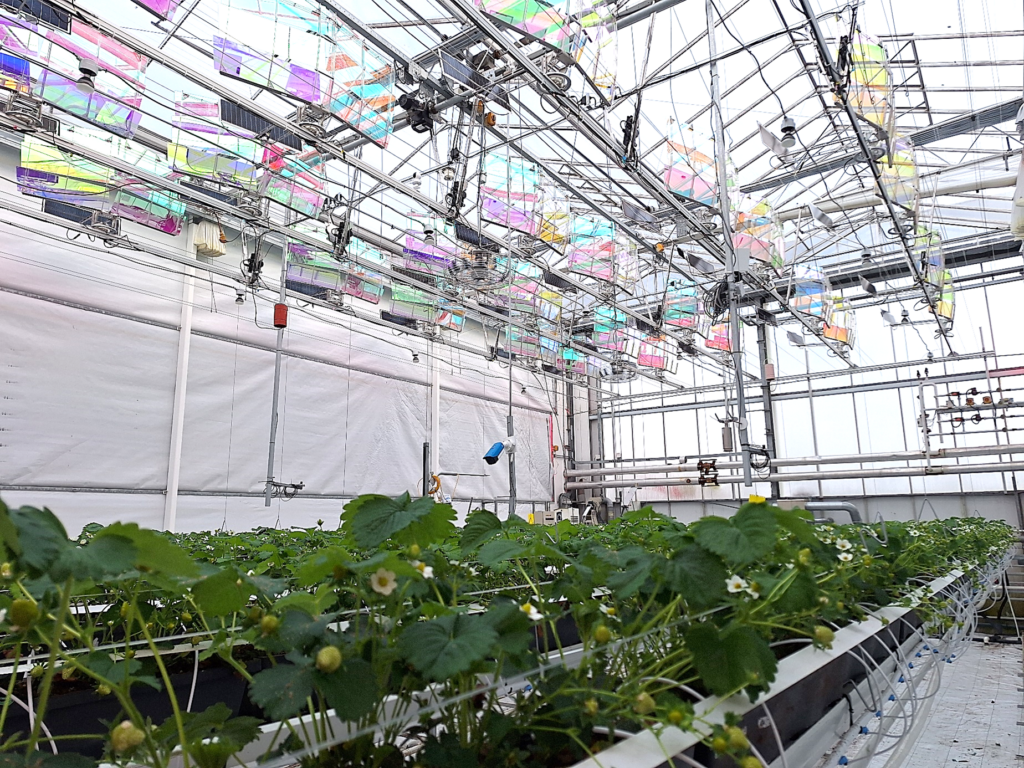
To further scale up large-scale onshore solar energy generation, solutions are required that can be integrated spatially, socially, and with regard to the electricity system. Horticulture offers a unique opportunity to realize large-scale solar energy. The sector comprises 10,000 hectares of greenhouses, where major grid connections are already in place. High-tech horticulture is a major energy consumer. This offers an opportunity to link decentralized generation and consumption. Furthermore, greenhouse horticulture is under social and economic pressure to move away from gas-fired combined heat and power (CHP) and switch to sustainable sources. However, the combination of horticulture and PV is hardly applied yet. Conventional solar panels block the light necessary for crop production. In this project, a unique PV concept is being developed—named GrowSolar—that generates large amounts of sustainable energy using spectral filters without loss of crop production.
Objective
The primary goal of the GrowSolar project is to unlock 10,000 hectares of horticultural land for the generation of approximately 5 GW of solar PV: a 25% increase in Dutch PV capacity through multiple land use. The second goal is to radically accelerate the energy transition in horticulture by integrating the innovative PV system with other forms of electrification, thereby offering a total solution as a sustainable alternative to CHP. To accelerate the electrification of this sector, integral system innovation is required. The necessary transformation does not call for incremental product innovations in PV systems, smart energy management, or new installation processes, but for a breakthrough in all of these simultaneously. Therefore, collaboration across various areas of expertise is taking place within this project to arrive at a total solution. The consortium consists of innovators Voltiris and SkyTree, research institutions TNO and Improvement Centre (Delphy), growers Division Q (Koppert Cress) and Lingezegen Energy, and technical suppliers Horconex and Hortivation.
Short description
The process begins with investigating a suitable approach/boundary conditions for the intended system innovation. To this end, various workshops are organized with a broad group of stakeholders. Subsequently, the GrowSolar system is further developed regarding performance, robustness, and integration. Tooling is developed to provide growers with insight into various electrification strategies. A smart energy management system is developed to optimize supply and demand behind the meter. The prototypes of the GrowSolar system and the energy management system are tested in an operational environment. Finally, a prototype of the GrowSolar system is developed and tested in an energy hub application. The project results are disseminated within and outside the sector.
Result
By 2027, GrowSolar will have achieved the following results:
1. A validated prototype of the GrowSolar concept, including validation trials at field locations.
2. Algorithms and control systems for integrating GrowSolar with other forms of electrification (heat pumps, direct air capture, storage) to create a total solution as an alternative to CHP for both individual horticultural companies and collaborating energy hubs.
3. A scalable production, installation, and operational process for the GrowSolar concept, including a knowledge base for training technical specialists and installers.
4. Tooling enabling the industry to integrate and scale up GrowSolar within existing operational processes, norms, and standards.
5. Publication and dissemination of project results within the sector and beyond. The project results remove the barriers facing the sector to integrating PV into greenhouses and accelerate the transition from fossil CHP to sustainable sources.
Research period: January 2025 – December 2027
The project is being carried out with Top Sector Energy funding from the Ministry of Economic Affairs and Climate Policy, implemented by the Netherlands Enterprise Agency.
The specific funding for this project concerns the MOOI grant round 2020.