GREEN-SENSE: Improved Growth Regulation and Energy Efficiency through New SENSors
What is the objective of this research project?
Within GREEN-SENSE, we are taking major steps towards autonomous cultivation, making the most efficient use of energy, labor, and nutrients. We do this by developing and deploying advanced sensor technologies in the greenhouse. We focus on new sensors that are crucial for data-driven and ultimately autonomous cultivation, with a focus on affordability, robustness, and integration into existing sensor networks. Initially, we are focusing on tomatoes, the most important greenhouse fruit crop in the region—a complex crop where plant-oriented sensors have high applicability and significant added value. In doing so, GREEN-SENSE contributes to the energy efficiency and overall sustainability of the greenhouse horticulture sector in Flanders and the Netherlands. The developments and demonstrations within GREEN-SENSE promote the use of advanced technology in the sector and stimulate cross-sectoral innovation capacity within the region.
How do we achieve this?
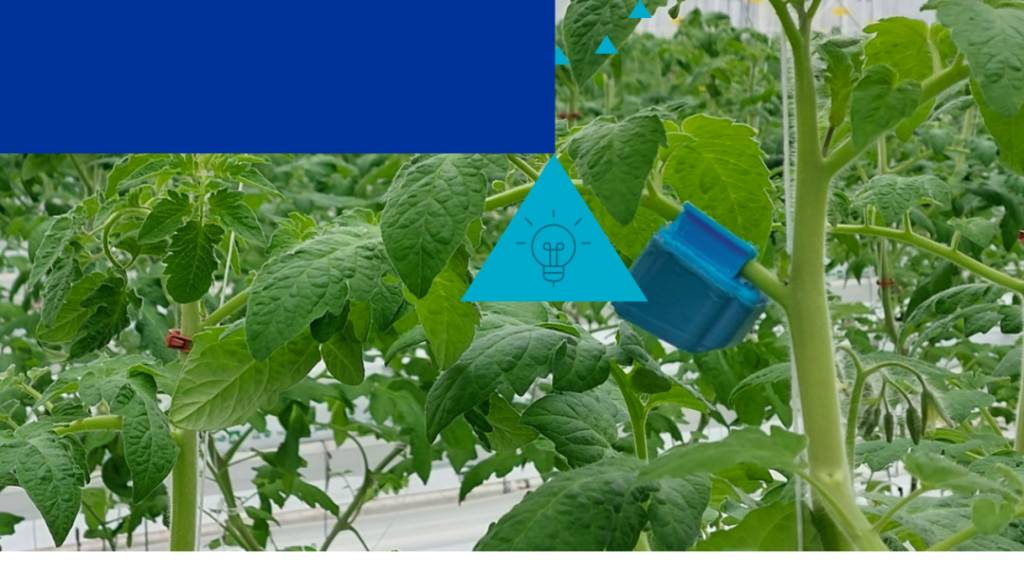
To achieve these objectives, we are focusing on eight new sensor technologies, in different TRL levels, which are being further developed in WP3: (1) a motion sensor capable of detecting plant stress, (2) a leaf structure sensor for detecting changes in leaf microstructure and pigment concentrations, (3) a sap flow sensor for detecting deviations in water transport (evaporation, water uptake), (4) a water content sensor for measuring changes in stem permittivity (water content) for detecting drought stress, among other things, (5) a fungal spore sensor for detecting spore pressure, (6) a sensor protocol for light interception to determine the leaf picking strategy (photosynthesis and evaporation), (7) a sensor setup for head thickness to indicate crop balance, and (8) a sensor protocol for detecting leaf status and constituents as an indication of assimilate status. Most of these sensors are currently not present in the greenhouse, but are crucial for further optimizing tomato cultivation. For some sensors (e.g., sap flow), commercial variants are currently available, but these are often too expensive, not accurate enough, too difficult to interpret, or cannot be integrated into existing networks. Adding these eight sensors to the sensor network will contribute to more energy-efficient cultivation, allowing for a more precise response to plant needs and timely adjustments in the event of suboptimal growth or stress. This will increase production efficiency, which can also represent economic added value for growers.
After development in the laboratory, the sensors will be tested in the semi-commercial greenhouses of PCH and Delphy Improvement Centre for practical use and under various conditions. Because the different sensors also have different TRL levels at the start of the project, we can begin greenhouse trials right from the start. The sensor data collected in these tests will be supplemented with (manual) measurements of crop status and will be used in a later phase of the project to develop cultivation recommendations, so that growers know what action to take based on the sensor values obtained. In addition, the sensors will be integrated into the existing commercial sensor network. Finally, the sensors will be validated and demonstrated so that the various target groups can start working with them. We also aim to make an initial translation to other crops, such as lettuce, cucumber, chicory, and chrysanthemum, to determine the potential added value of the new sensors in these crops and whether a follow-up trajectory is required for further crop-specific optimization. The project will conclude with the development of a roadmap in which we determine how the new sensors can contribute to autonomous cultivation and which additional steps are still missing.
Research period: May 1, 2026 – April 30, 2029